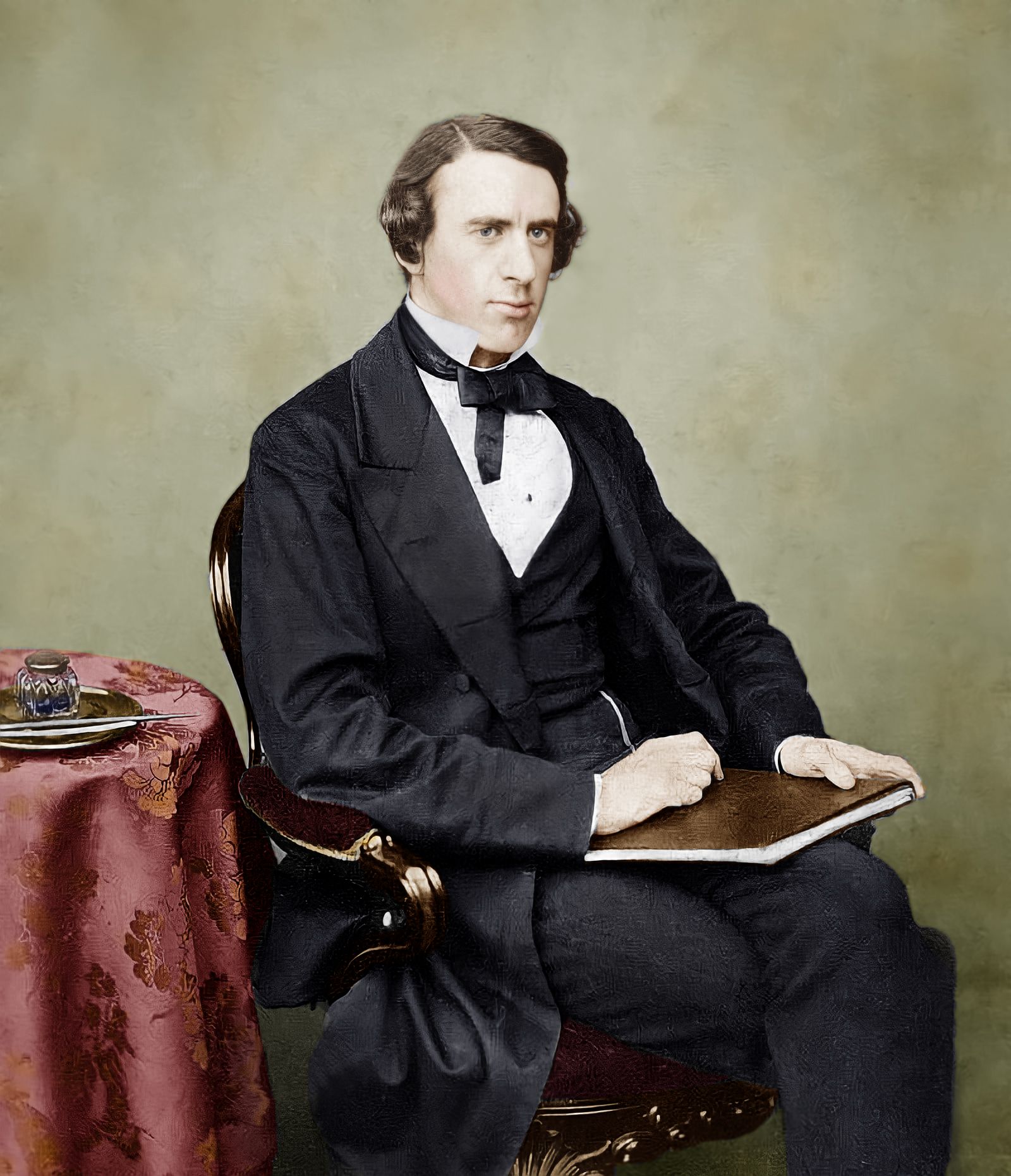
 Sir Leslie Stephen (November 28, 1832 – February 22, 1904) was a towering figure in late-Victorian intellectual life, renowned as a philosopher, essayist, biographer, and
literary critic, as well as a pioneering mountaineer.
Sir Leslie Stephen (November 28, 1832 – February 22, 1904) was a towering figure in late-Victorian intellectual life, renowned as a philosopher, essayist, biographer, and
literary critic, as well as a pioneering mountaineer.Queer Places:
Eton College, Windsor, Windsor and Maidenhead SL4 6DW
King's College London, Strand, London WC2R 2LS, United Kingdom
University of Cambridge, 4 Mill Ln, Cambridge CB2 1RZ
46 Gordon Sq, London WC1H 0PD, UK
Highgate Cemetery East, Swain's Ln, London N6 6PJ, United Kingdom
Sir Leslie Stephen (November 28, 1832 – February 22, 1904) was a towering figure in late-Victorian intellectual life, renowned as a philosopher, essayist, biographer, and
literary critic, as well as a pioneering mountaineer.
Born in London to a prominent evangelical and abolitionist family (the "Clapham Sect"), Stephen was educated at Eton College, King's College London, and Trinity Hall, Cambridge. He graduated with a degree in mathematics in 1854 and subsequently became a fellow and tutor at Trinity Hall.
Initially destined for the clergy, Stephen experienced a crisis of faith. By the mid-1860s, he had fully abandoned orthodox Christianity, becoming a prominent champion of agnosticism. His definitive philosophical statement on the subject was published in An Agnostic's Apology (1893).
Stephen moved to London in 1864 to pursue journalism. He served as the first editor of the prestigious Cornhill Magazine (1871–1882) and is best remembered as the founding editor of the monumental Dictionary of National Biography (DNB) (launched in 1882), a task that cemented his legacy as a master of Victorian biographical scholarship. He also wrote major critical works, including History of English Thought in the Eighteenth Century (1876) and The Science of Ethics (1882).
Aside from his writing, Stephen was one of the leading figures of the "Golden Age of Alpinism," making numerous first ascents in the Swiss Alps, including the Schreckhorn and the Bietschhorn.
Stephen was married twice. His first wife was Minny Thackeray (daughter of the novelist William Makepeace Thackeray), who died in 1875. In 1878, he married Julia Duckworth, with whom he had four children: Vanessa (Bell), Thoby, Virginia (Woolf), and Adrian. Following Leslie's death in 1904, his children and their university friends formed the core of the famous Bloomsbury Group.
Leslie Stephen was a member of the elite, semi-secret Cambridge intellectual society known as the Cambridge Apostles.
He was elected to the society during his undergraduate years at Cambridge, entering a long tradition of intellectual free-thought.
The Apostles encouraged unreserved debate, radical inquiry, and close homosocial bonding. While Stephen’s own generation used the society primarily for philosophical, religious, and political debate as they transitioned away from orthodox Victorian constraints, the group provided an intellectual incubator that shaped his lifelong disdain for dogmatism.
While Leslie Stephen’s personal life was conventionally heterosexual—anchored by his two marriages and fatherhood—his life, familial legacy, and intellectual networks intersect significantly with LGBTQ history:
The Cambridge Apostles historically fostered an intense, all-male environment. By the late 19th and early 20th centuries—particularly under the later influence of philosopher G.E. Moore and figures like Lytton Strachey—Apostolic bonds frequently blurred into homoeroticism and same-sex partnerships. Though Stephen predated the most explicitly "queer" generations of the Apostles (such as Strachey, John Maynard Keynes, and E.M. Forster), he was part of the institutional lineage that sustained the club.
Stephen’s direct connection to LGBTQ history materializes most clearly through his children and the birth of the Bloomsbury Group. When Stephen's son, Thoby, went to Trinity College, Cambridge, he befriended a group of men—mostly Apostles—who were openly or complexly navigating same-sex desire.
Men like Lytton Strachey, John Maynard Keynes, and Leonard Woolf (who married Leslie's daughter, Virginia Woolf) brought the radical anti-Victorian, pro-homoerotic ethos of the later Apostles directly into the Stephen family home at 46 Gordon Square. Thus, Leslie Stephen’s domestic circle evolved into a foundational space for some of the 20th century's most prominent literary figures who actively challenged traditional Victorian constraints regarding gender and sexuality.
References:
 The Cambridge Apostles, 1820-1914: Liberalism, Imagination, and Friendship in British Intellectual and Professional Life 1st Edition by W.C. Lubenow |
Other references:
Support this project
This website is a passion project researched, developed, and funded entirely by me. If you find the content valuable and would like to help support the ongoing research and hosting costs, any contribution is deeply appreciated.
Thank you for keeping this independent resource alive!
My books on Amazon: Elisa Rolle's books